
What the radius clause means & why promoters include it
Want to stop burning bridges with promoters? Here's everything you need to know about radius clauses and how to track them using SystemOne.

Quentin Van Damme
Anna Breitenfeld


When you book a highly anticipated artist for a major festival, the last thing you want is for them to play a free club show right across the street the night before.
This is where exclusivity comes into play. Protecting a promoter's investment is a compromise and a core part of every booking agent's job. Let's break down what a radius clause is, how it works across different regions, and how you can manage these requirements with SystemOne.
The case for a radius clause
A radius clause is a form of non-compete agreement specifically tailored for the live music sector. It's a contractual provision stipulated by a concert promoter that restricts an artist from performing within a certain geographic radius of the venue for a specified period before and after the show.
How big the clause gets depends on the act. A club show might run 50 km (30 miles) / 30 days either side. A festival headliner can be locked out of an entire region for months.
For example, Coachella's 2018 contracts were challenged in a federal antitrust lawsuit for barring artists from playing competing festivals across five western US states for nearly five months.
Promoters take on massive financial risk to host live events. They pay artist guarantees, secure venues, and fund marketing campaigns. Some shows are marketed a year in advance—it's high risk to lose that kind of hype.
The radius clause exists to protect this investment by ensuring the local market isn't diluted.
If fans know they can see an artist for half the price a week later in a nearby city, ticket sales for the main show will plummet.
Similarly, a main act could be an opener at a large festival for a bigger act. Fans will know how to get the best bang for their buck, especially if they're going to that festival anyway.
For booking agents (and the managers who work alongside them), negotiating exclusivity is one of the very first steps in securing a tour date. Quentin Van Damme of Ground Control Agency notes that this happens during what he calls "the hunt"—when agents first reach out to festival bookers to pitch their rosters.
Before a contract is even drafted, the boundaries of exclusivity must be established.
{{quentin-gca-11}}
Read more about what the artist booking process entails.
Radius clauses across different regions
Where the show happens shapes how a radius clause holds up. Local competition law decides what's enforceable.
To get an idea of how this works in different regions, check out the differences between USA, EU, and UK legislation:
USA
Radius clauses are standard practice in the US.
While they've occasionally faced antitrust lawsuits—plaintiffs have argued they create illegal monopolies, particularly around major festivals—courts generally uphold them as a reasonable mechanism to protect a promoter's economic interests.
EU
The EU strictly regulates anti-competitive behavior under its competition laws.
Standard radius clauses are permitted, but overly broad clauses that cross country borders (a festival in Germany blocking an artist from playing in neighboring France or Belgium, for example) can face heavy scrutiny for restricting the free movement of services within the single market.
UK
Under UK law, radius clauses are viewed through the lens of the "restraint of trade" doctrine.
To be legally enforceable, the promoter must prove the clause is strictly necessary to protect a legitimate business interest and isn't overly broad in time or distance.
Note: We're not lawyers. For binding legal advice on specific contracts, consult a music industry attorney familiar with the relevant local law.
What counts as reasonable?
A "reasonable" radius clause depends entirely on the size of the artist and the market.
- Major festivals can often demand a 500 km (300-mile) radius and a blackout period of 90 days before and after—Lollapalooza and Bonnaroo have both used clauses in that range.
- Club shows usually require a much smaller footprint of 50–80 km (30–50 miles) for 30 days before and after.
- Urban vs. rural markets are not equal. An 80 km (50-mile) radius in densely populated Europe might block out several major markets in a country at once (Amsterdam, Utrecht, and Rotterdam, for example), whereas that same 80 km (50-mile) radius in the American Midwest might not even reach the next major city.
Here are some common templates agents encounter:
- The standard club radius: 100 km (60 miles) / 30 days prior / 15 days post-show (protects the immediate local ticket market).
- The festival anchor: 500 km (300 miles) / 90 days prior / 60 days post-show (ensures the festival is the only place to see the artist in that region for the season).
- The hard ticket exception: blocks other festival appearances but allows the artist to play their own headline club show within the radius.
- The unannounced support clause: restricts headline shows but allows the artist to appear within the radius as the unannounced opening act for a large arena tour.
Putting a radius clause to work
A radius clause should be clearly defined in the performance contract or deal memo, alongside other negotiated items such as the artist rider. It must explicitly state the distance (the radius) and the timeframe (the blackout period).
Example clause:
"Artist agrees not to perform, announce, or advertise any other public performance within a 100-mile radius of the Venue for a period of sixty (60) days prior to the Event and thirty (30) days following the Event, without the prior written consent of the Promoter."
That gets the clause on paper. When you're routing a tour with 40 dates, keeping overlapping blackout dates and geographical boundaries straight in your head is impossible.
SystemOne tracks standard calendar availability and contractual exclusivity.
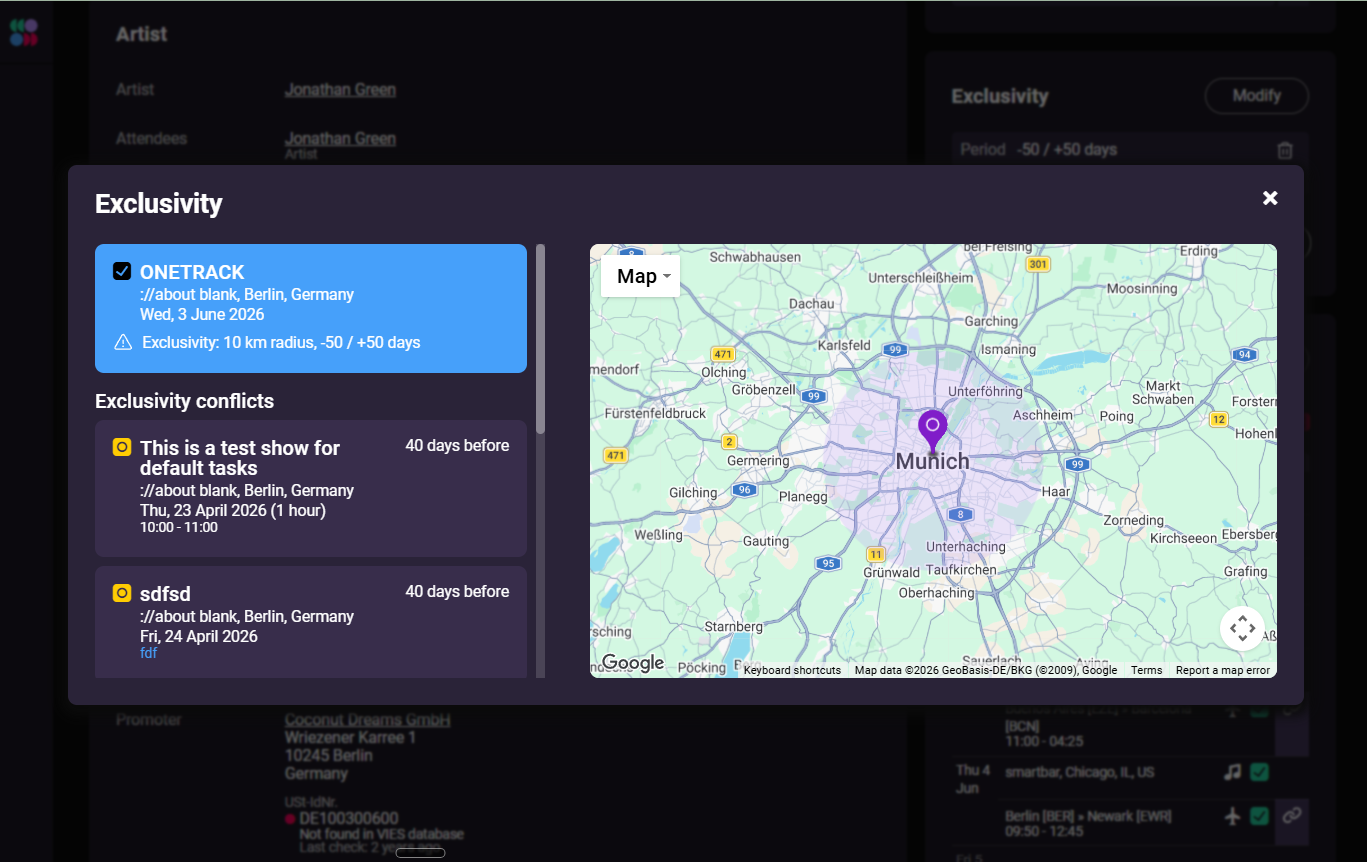
The platform's exclusivity check ensures that even if an artist is technically "free" on a specific date, you'll know immediately if they're contractually barred from playing a specific region due to an active radius clause. The show planning module has a built-in conflict-detection system.
Pro tip: Log the radius clause the moment the deal memo is signed, not when you start routing the next leg of the tour. Catching a conflict at routing stage is expensive—sometimes you've already announced shows.
Here's how to use it:
- Draft the deal memo. When entering show details, click on the New or Modify button in the exclusivity card in the right-hand column of the view and add the exact distance and timeframe of the radius clause you've negotiated with the promoter.
- Set automated reminders. Use SystemOne's task reminders to get notified the moment a blackout period officially ends—the green light to safely announce the next leg of the tour in that region.
- Check for conflicts. When a new booking request comes in, review the itinerary map and existing deal memos to confirm the new venue doesn't breach the geographical or temporal boundaries of an already-signed contract.

By tracking exclusivity clearly, you can confidently route tours without fear of legal breaches or damaged relationships with key promoters.
This lets you legally "stack" dates. Your artist can play a major festival in July, then safely announce a return club tour in the same city for November the moment the festival's radius clause expires. Clean, profitable, and nobody gets burned.

Radius clauses shouldn't be a blocker
Radius clauses are a necessary friction in the live music industry. They protect promoters from financial exposure and guarantee that events retain their unique draw.
Navigating them well requires a solid grasp of geography, timing, and local law—but it's a lot easier with the right tools. SystemOne's exclusivity check and automated reminders mean you can maximize your artists' earning potential without ever overstepping a contractual boundary.
Want to see our exclusivity check in action? Book a demo or request a free trial.
"You're talking deals, you're talking exclusivity, you're talking all the specs and the billing and so on."


Recent articles

.png)

Never miss an update


