
How to run a tour: 19 years of lessons from Cuca
What do Fatboy Slim, Honey Dijon & Charlotte de Witte have in common? A Brazilian tour manager called Cuca Pimentel.

Cuca Pimentel


It started with a phone call on a Saturday night in 2007. Cuca Pimentel had no plans when her friend Monique called from Tribe, a rave that was huge in Brazil at the time.
"What are you going to do tonight?" Monique asked. "Nothing." "Do you want to make some money?"
The job sounded simple. A driver would pick Cuca up, she'd collect a DJ from his hotel, look after him at the party, and take him back. "Easy money," she thought. The DJ was Stephan Bodzin, and she never really stopped doing tour management since then.
But for years, she didn't have a name for what she did. "I always said, I'm a DJ nanny," she told us. Today she's a tour manager who's looked after Fatboy Slim, Honey Dijon, Solomun, and Charlotte de Witte. She was also a speaker at ADE in 2026.
We asked how she runs a tour. Cuca mostly works with international DJs touring Brazil, sometimes alongside the artist's own tour manager and sometimes alone, so this is one tour manager's method in one busy market. If you're a tour manager for a band and you drive the truck, your workflow will look a little different.

1. Study the itinerary before you do anything else
Ask Cuca how much planning she does, and you get a short answer.
"No planning. They give me the itinerary sheet, and I have to deal with the logistics. That's my job."
But it’s not completely hands-off. On the NOMMADCAST podcast, she describes how she splits the work in two: a macro side of flights, hotels, and drivers, which someone else has sorted by the time it reaches her, and a micro side that runs on the clock and belongs to her. Who handles the macro side depends on the tour. On a small club run, the tour manager may well be booking the hotels, too.
Either way, your job starts when the sheet lands. For the big runs, she writes it all out by hand.
{{cuca-tour-2}}
The pages then travel with her. Whether you write it out or not, here's what we'd check, after more than 20 years of being musicians and working with booking agents and touring artists:
- Every pickup time against the real drive on that day, not a normal day
- Flight numbers, airports, and terminals, plus the gap between landing and the next thing on the sheet
- Who's driving each leg, and how to reach them
- Hotel addresses, and who's checking in
- Who to call at each venue or festival, by name
- Stage and set times, and when you have to leave to make them
- Any leg with no slack, because that's where your day will go wrong first
2. Trust the locals over the map
During Carnaval, street parties called blocos close roads all over São Paulo and Rio. Cuca loves them. She also has to get a DJ through them on time.
A friend of hers once warned a visiting tour manager that the streets would be closed. He'd seen 20 minutes’ commute on Google Maps and decided it was too early to leave the hotel. "He was completely inflexible," Cuca says. "And what happened? Of course they arrived late."
"If you don't talk with the locals, you can mess with the entire tour. You need to listen to the people who know their city better than you do," says Cuca
So she asks the driver first. "They know better than me how the traffic works," she says. Her question is always some version of this: "Do you think it's okay for us to leave at this time, or could we be a little bit earlier?" Then she checks Waze. If the drive looks shorter than expected, the artist gets to stay a little longer, with no rush.
Some of her artists fly private at peak season, because the airports are packed. Someone still has to get everyone to the plane through the same traffic.
Cuca has a special outlook on all of this work:
{{cuca-tour-3}}
3. Treat the clock as the job
What makes a good tour manager? Cuca insists that a good tour manager has a keen sense of responsibility, respects everyone, and is humble and proactive. But the number one thing a tour manager absolutely must be is punctual. "Oh, you have to be on time all the time," she says.
On NOMMADCAST, she says you have to be "British-punctual," like Queen Elizabeth. She's done four states in 24 hours. She once started a four-date Carnaval run on one hour and 20 minutes of sleep. That’s why the itinerary had to be in her head and ready to go.
The other half of the job is the person in the back of the car. Cuca can work with two, three, or four different DJs in a month, and jet lag and short nights can make people difficult to work with. So she’s learned to read the artist before she says anything. Some people want to chat and party, others don’t.

It can be stressful managing a new artist. Even now, a first job with an artist makes Cuca nervous. "You have to feel the vibe of the artist. Just say what you have to say: it's going to take 40 minutes from the airport to the hotel. Okay, that's it. Mouth closed."
4. Fix it yourself, and say when you can't
Something will go wrong. Cuca's first instinct is not to pick up the phone. At peak times, the agents she works with are looking after a lot of artists at the same festival, and they don't need a call about everything. "You need to think fast and just go get it," she says.
A fast decision can still be a bad one, though, and hiding it makes it worse. You have to be humble enough to say, okay, I did this, it didn't work, what can I do now? Otherwise, it can really make a solvable problem blow up in a bad way.
So if you realize you missed the mark trying a workaround or detour, phone the agent and tell them what you did, what happened, and what you need from them right now.
Booking agents: on the agency side, it helps to settle a few things before the run starts. Top of mind:
- What can the tour manager decide alone
- What budget can they spend without asking
- Who picks up the call if something goes wrong at 3 am
Having this kind of structure in place will save time in an emergency.
5. Keep every receipt
How the money works depends on who you're working for. One agency Cuca worked with sent money ahead at a daily rate for each person. What works best for her is paying for everything the artist needs on her own credit card, keeping the receipts, and filling in an expense sheet. The agency reimburses her afterward, and she hasn’t had any complications with this approach.
And yes, it can put real costs on your own card. Cuca once met an artist who'd arrived sick from a festival abroad. She called a friend at the venue to find a doctor, then went to the drugstore herself for the medicine. It was rough.
But one thing you definitely want to avoid is a gray area around the budget. Have a conversation with your agency around the expenses that can be incurred for the tour and who pays what. Put it in writing to make sure everybody understands what’s been agreed.
6. Where your agency meets the road
Cuca doesn't use tour software. Paper and a good memory work for her, and we're not about to argue with 19 years of results.
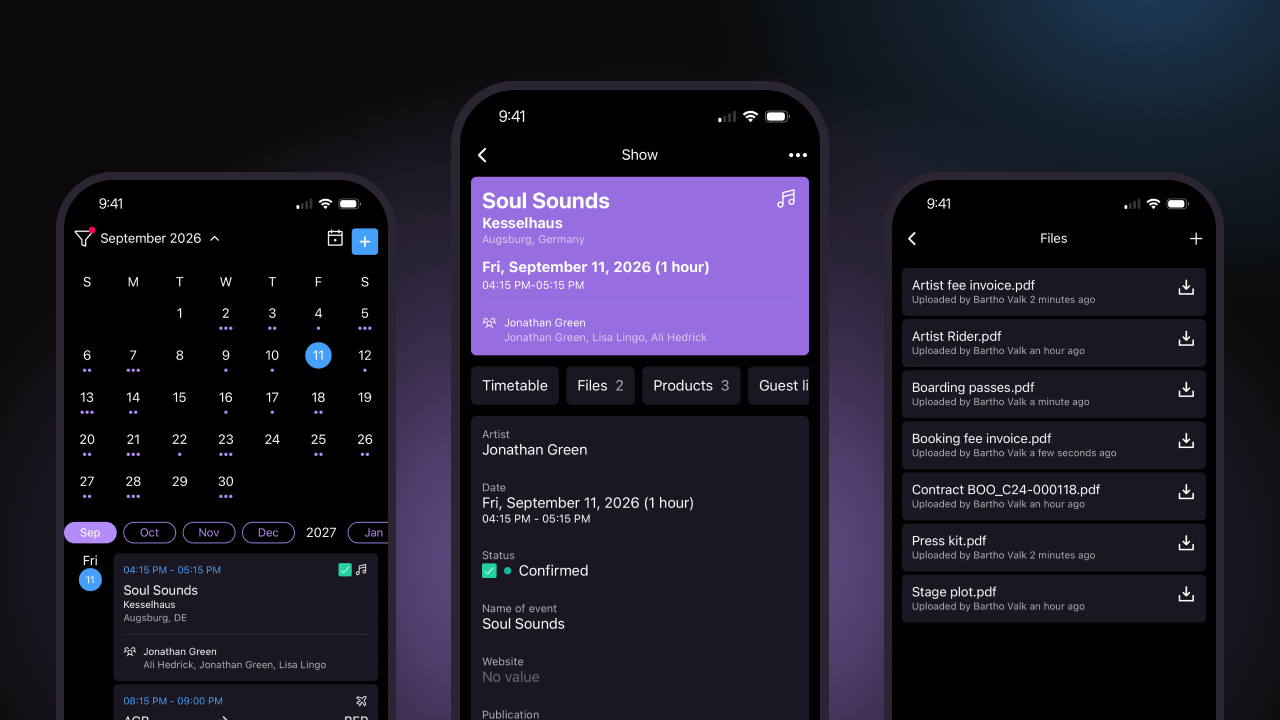
But a tour manager can only study what they've been sent, and that usually starts with the agency's workflow. The booking agent must get the correct version of the plan into the tour manager’s hands and keep it up to date. That's one of the parts SystemOne helps you manage. Here’s a quick overview of how it works:
- The agent invites the tour manager in. You can add tour managers as external stakeholders at no extra cost.
- Keep travel in one place. Enter a flight number and airline to populate the flight details automatically. Trains and ground transport sit alongside them with Google Maps links and driver details.
- Share it to the road. Tour managers can check shows, flights, trains, and ground transport on the SystemOne mobile app in real time, with offline access for when the signal drops.
- Export it for the paper people. You can export the full itinerary as a PDF and choose what gets shared with artists and crew.
It all works out when someone manages the itinerary
There's a saying: in the end, it all worked out, and we don't know how.
But after chatting to Cuca, we kind of understand why having a great tour manager pays off. Two months before Rock in Rio 2026, Fatboy Slim's team got in touch with Cuca. The festival has its own tour managers, and they didn't care. "We want you," they told her. "We don't want them." In Brazil, she says, when the team is winning, you don't mess with it. You keep working together until it doesn’t work anymore.

If you want to see the features available to tour managers on SystemOne, book a demo or request a free trial.
FAQ
How do you run a live music tour?
What should be on a music tour itinerary?
What do you do when a music tour runs late?
How do tour managers handle expenses on the road?
What software do tour managers use?
"The most important thing for a tour manager is to study your itinerary before the tour. I use my itinerary sheet and my mind. When I have big logistics, like for Carnaval or New Year's, I like to write it down. I absorb it better."

"The tour is an ecosystem. You have to understand how it works. It's a living thing, it has a heart. So you have to work with it, not against it."
Recent articles


Never miss an update


